Logical Thinking for Kids: Practicing Reasoning with Wooden Toys
Logical thinking isn't built by memorisation; it grows slowly through repeated handling, comparing and correcting. Starting with how young children think, this article explains how rule-based wooden toys can gradually develop reasoning and strategy skills.
By: BrainWood Academy Editorial Team Published About 8 min read
What logical thinking looks like in early childhood
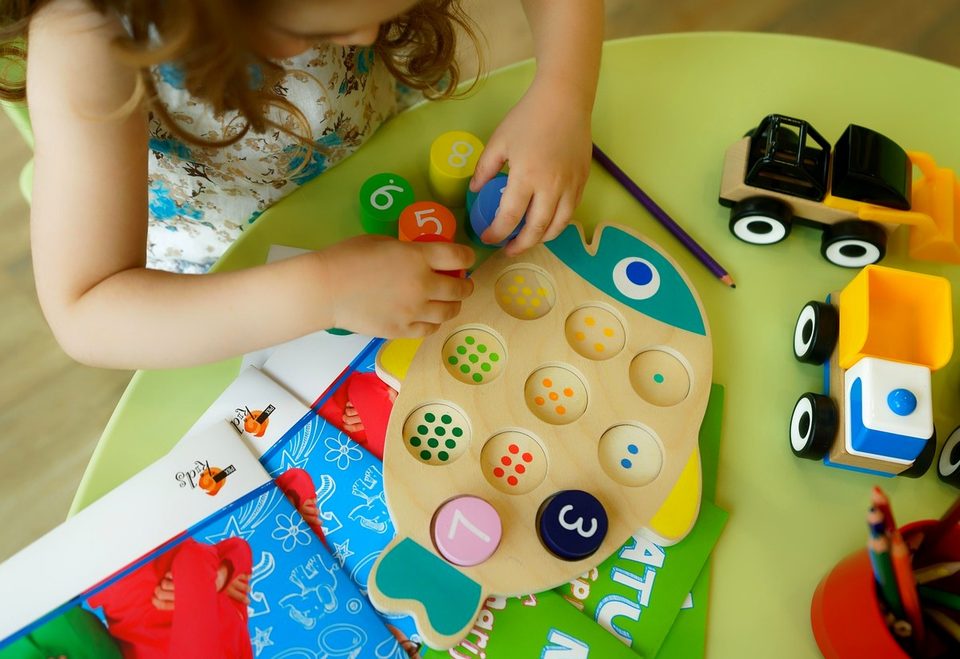
When it comes to logical thinking, many parents first picture math problems or coding classes, but in early childhood it more often hides in small everyday actions. A child sorts blocks by colour, finds that a round wooden piece won't fit into a square hole, or wonders "what will happen if I place this one first?" All of these are early forms of reasoning. Thinking at this stage relies mainly on hands-on manipulation: children need to touch, move and see the results with their own eyes and hands in order to form concepts.
Young children's logic doesn't work through verbal deduction the way adults' does; it builds up through action and observation. They first notice an object's obvious features, such as size, colour and shape, and then gradually learn to consider two or more conditions at once. This shift from a single feature to multiple conditions is the main line of reasoning development. So rather than rushing children toward the standard answer, it's better to first give them ample opportunity to compare, try things out and discover differences.
Wooden toys are especially well suited to this stage because their weight, feel and feedback are so direct. If blocks aren't placed steadily, they fall; if a joint is lined up correctly, it locks tight. The result shows up right in front of the child, with no need for adults to explain much. Through this immediate feedback, children naturally link "what I did" with "what happened," and this cause-and-effect connection is the foundation for more complex reasoning later on.
Features of toys with clear rules
Not every toy is suited to training reasoning. Toys that can do this job usually share one trait: the rules are clear, and they are embodied in the toy's own structure rather than announced aloud by an adult. For example, a slot that only a particular shape can fit into, or a track that must be arranged in order to be completed: as soon as children handle it, they can feel where the limits are, and so understand that "this works, that doesn't."
Clear rules have another meaning too: the answer can be verified. When children finish, they can see for themselves whether it's right, without waiting for an adult's nod. This ability to check their own work matters because it keeps their attention on the thinking process rather than on pleasing others. When designing our teaching tools, we also try to give every challenge a clear finished state while leaving room for several different solutions, so children have direction without feeling there is only one path.
Beyond the rules themselves, the toy's levels of difficulty are also worth noting. A good rule-based toy keeps the entry barrier low enough that children are willing to start, then gradually adds new constraints as their skill grows. When choosing one, you can look at the following aspects:
- Whether the rules can be seen directly from the toy's appearance and structure
- Whether there is a clear result at the end that the child can judge for themselves
- Whether it allows several paths to try, rather than a single solution
- Whether the difficulty can be adjusted step by step without buying a new toy
- Whether the size and material of the pieces suit the child's age
From sorting and ordering to conditional reasoning
Logical ability develops in a roughly fixed sequence, and the earliest step is sorting. Children first learn to put like things together, for example dividing round and square wooden pieces into two piles, and only then can they handle finer differences, such as grouping the round ones further by size or colour. Sorting looks simple, but it is already practice in "finding what things have in common" and "ignoring irrelevant differences," which is the starting point of abstract thinking.
Once children are fluent at sorting, they can move on to ordering. Ordering asks children to compare several objects at once and find a pattern along one dimension, such as short to long or light to dark. They must hold a standard in mind and check each new object against it, which adds a layer of comparison beyond simple sorting. Teaching tools like wooden rods of different lengths and graded colour blocks make this comparison visible and tangible, so even if children can't explain it clearly, they can adjust the positions by feel.
One step higher is conditional reasoning, the kind of thinking that asks, "If this happens, then what?" The challenge is no longer simply about placing pieces; children must satisfy several conditions at once, such as a certain shape that cannot go in a certain spot, or a step that must be completed before the next one can begin. Puzzles like these require children to picture the outcome in their heads before they act, and to look back after a failed attempt to check which condition they overlooked. By moving gradually from sorting to sequencing and then to conditional reasoning, children build their thinking skills layer by layer on a solid foundation.
Let Children Talk Through Their Thinking
When children play with wooden toys, adults tend to care only about whether the answer is right and overlook how the child got there. In fact, reasoning only becomes truly visible when a child can put their approach into words, and that is when it can be corrected and strengthened. That is why we suggest deliberately leaving room for children to speak while they work.
Young children are still developing their language, so it is perfectly normal for their explanations to be incomplete. Adults don't need to rush to correct word choices. Instead, first acknowledge what the child means, then help organize it in simple sentences. For example, if a child says, "This goes here," you might reply, "You put the round ones on the left. Is it because they look the same?" Restating their idea like this helps turn a vague hunch into a clear reason.
How you ask matters more than what you ask. Instead of "Why did you do that?", try more specific, lower-pressure wording that makes it easier for a child to answer. Here are some questions that work well during play:
After asking, wait patiently and give the child enough time to organize their thoughts. If adults rush in with the answer, children get used to waiting for instructions instead of working things out themselves. A few seconds of silence is often exactly when the thinking happens.
- Which part did you look at first?
- What would happen if we used this piece instead?
- How did you know this piece could go here?
- Is there another way to do it?
- What do you plan to do next?
Failed Attempts Are Learning Material Too
While solving a puzzle, children inevitably get stuck, put pieces in the wrong place and start over. This is not wasted time; it is the most direct kind of learning material. Every mistake tells the child that a path doesn't work, and the reason may lie in the shape, the order or the conditions. Children who can find clues in their failures often understand how to think better than those who succeed on the first try.
How adults respond to a child's mistakes shapes how the child sees errors. If we step in to fix things right away or show disappointment, children may start to fear trying. Instead, saying with a curious tone, "Hmm, it doesn't seem to fit. What do you think is different?" shifts attention from frustration to observation and encourages children to analyze the cause themselves.
Wooden toys have one advantage: their rules are fixed, and the results don't change with an adult's mood. Children can safely repeat their experiments until they discover the pattern on their own. We believe that rather than aiming for a correct answer on the first try, it is better to encourage children to look back at what they just attempted, say where things started to go off track, and set out again with a new idea. When failure is treated as data rather than a grade, children find the courage to take on harder puzzles.
Gradually Turning a Puzzle into a New Challenge
Once a child is familiar with a puzzle, repeating the same game quickly loses its challenge. At that point, adults can tweak the rules without changing the toy, so the old toy poses new problems. The guiding principle is to change only one condition at a time, so the child can clearly feel the difference instead of being confused by too many changes at once.
Common ways to adjust a puzzle include limiting the number of pieces, adding conditions, shortening the time, or reversing roles so the child sets the puzzle for an adult to solve. For example, a task that originally asked only for sorting blocks can become "finish it using just three pieces," and instead of an adult setting the goal, the child can design a puzzle and invite the family to try it. Moving from solver to puzzle-maker, children must first understand where the rules begin and end, which lifts their thinking to a higher level.
Judging the right level of difficulty comes down to observation. If a child finishes easily, add a little more challenge; if the child grows restless and keeps giving up, step back to the previous stage and let successful experiences take firm root first. The design philosophy behind BrainWood Academy's teaching tools is that a single piece can be rearranged into new ways of playing as the child grows, accompanying them from simple comparisons to careful strategic thinking.
Key takeaways
-
Talk It Through Encourage children to explain their approach in their own words and guide them with specific, low-pressure questions, so their reasoning becomes visible and gets stronger.
-
Mistakes Are Material Treat failed attempts as data for observation and analysis, and replace blame with curiosity, so children dare to keep taking on harder puzzles.
-
Adjust Step by Step Change only one condition at a time and adjust the difficulty based on the child's response, so the same wooden toy keeps producing new challenges.
Sources
This article is for general information only and does not constitute professional advice.